
Cara Lam: From Rural Japan to the World State with Team USA Dragon Boat
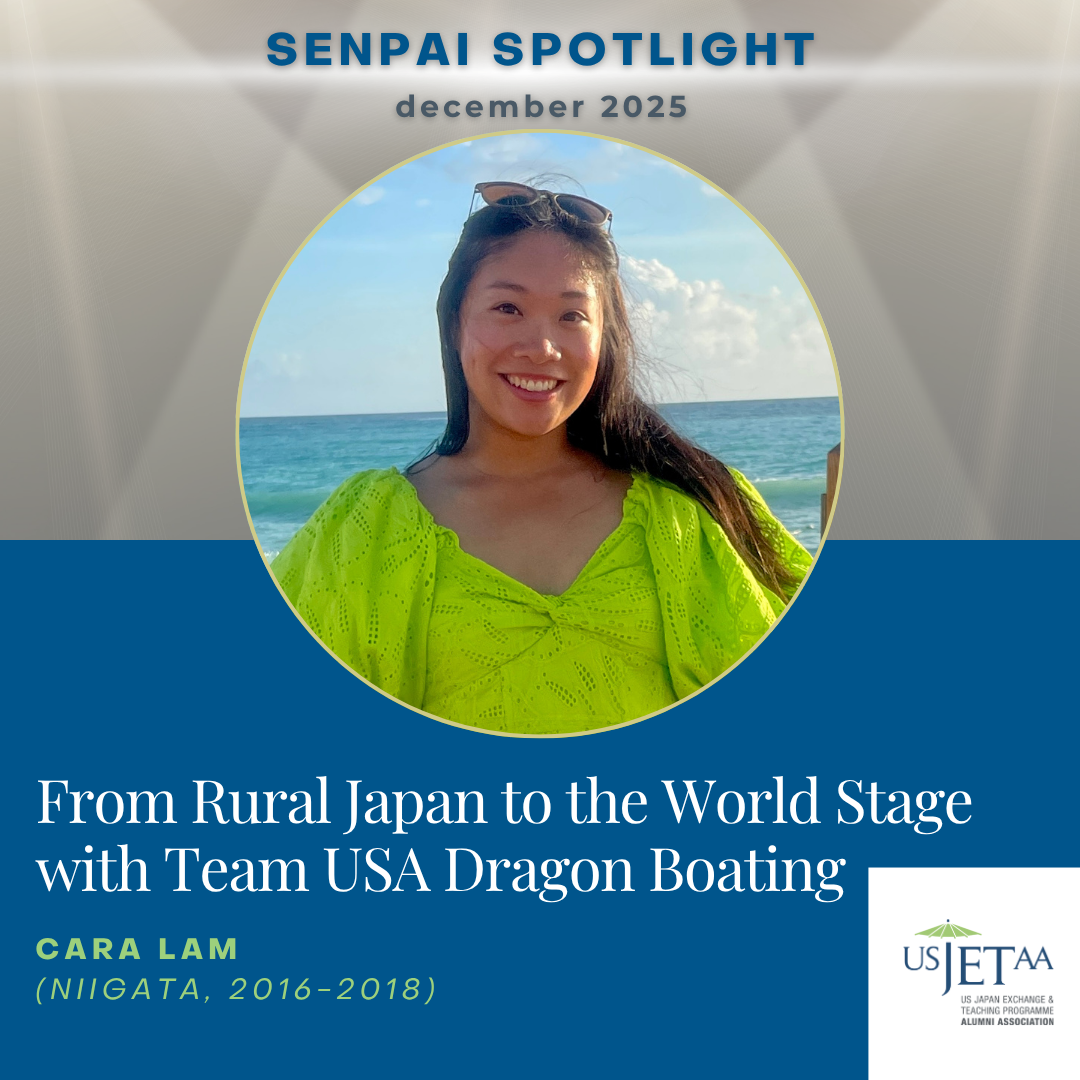
Cara Lam (Niigata, 2016-2018)
USA Dragon Boat World Championship Competitor
Interviewed by Bobby Nawbary (Aomori, 2024-present)
Cara Lam's journey into the JET Program and Japan was inspired by her multicultural upbringings and her undeniable passion for adventure. Living in Hong Kong at a young age, she remembers her family's nostalgic summer vacations in Osaka and Japan's gentle pull on her heart. Cara developed a surprising resilience and ability to thrive in new places through her high school life in Australia, an ocean away from her family. She would later attend University of California Los Angeles (UCLA) in the States, her springboard to Japan and eventual home for three years. Cara credits the JET Program for transforming her sense of adventure into purpose. Cara's unique optimism has allowed her to make a lasting impact in Japan and the United States. Representing the United States at the Dragon Boat World Championships in the summer of 2025 in Germany and reconnecting with her former students in Japan, Cara's adventures are still going strong, even after Japan.
Why was Japan important for you to experience? Moving to Australia then the US both without your family close by… it seems like you would have been homesick or ready to settle down.
Cara's earliest memories of Japan are watching dubbed Japanese cartoons and family summer vacations- it was an integral piece of her childhood that left her longing for more.
“Summer nights in Osaka. The feeling of those crowded streets and everything being so alive, that's something I never forgot. Japan was an important part of my childhood and the reason I am who I am today. That exposure to the culture early on shaped my personality in many ways.”
But, before she could experience life in Japan, she would attend a boarding school in Australia while her family resided in Hong Kong. Cara would struggle without her family support network and the language barrier, but she took initiative to break out of her own stereotype and redefine others’ perception of her.
“I moved to Australia when I was 15 with little to no English skills. I realized that I should probably learn English well before I graduate and actually make friends.”
“I had to challenge myself, so I asked my Australian roommates to correct my English and I watched a ton of English shows. I made friends with people outside of my comfort zone. This is where I really started to appreciate cultural exchange.”
With strengthened confidence gained from Australia, she welcomed the next challenge- this time in the United States, where she was accepted into UCLA to study psychology.
How did the United States and your experience there lead you to apply for the JET Program?
“I missed my family. They invested a lot into my education and I wanted to work hard for them and myself. Moving to LA was quite the experience, but I felt the sky was the limit for me.”
Cara viewed America as a place where she could dream as big as she wanted and define her own life. It was in LA where Cara started to sense just how big her appetite was for adventure. In her sophomore year she decided to take a solo trip to Osaka. During her stay, a chance encounter with a few Assistant Language Teachers with the JET Program changed the course of her life forever.
“They were in Japan, they came from all over the world like me. They told me: there's this amazing program which can help you relocate to Japan and connect to the people and culture! I was immediately interested and realized during my trip that there were many aspects about Japan that I not only missed, but was still very curious about.”
Cara was beginning to understand that her identity was more malleable and complex than simply where she grew up, what languages she spoke and the ethnicity of her parents. Cara was actively creating her own identity and embracing discomfort for growth. She felt living in Japan would allow her to revisit her childhood, but also explore and stretch.
Cara knew this detour in her life came with a cost. The momentum she built in the US making connections and developing professionally would also be put to a standstill. She also had to challenge her parents’ expectations.
“My parents were not onboard with the decision to go to Japan. They worked really hard so I could have a good education abroad. It was difficult to explain where Japan fit in my life at that time.”
In the face of so many unknowns, Cara knew one thing for certain about herself: she could make the most of new experiences and accomplish anything she pursued wholeheartedly.
When you arrived on JET what were some of your goals and how did your placement affect you?
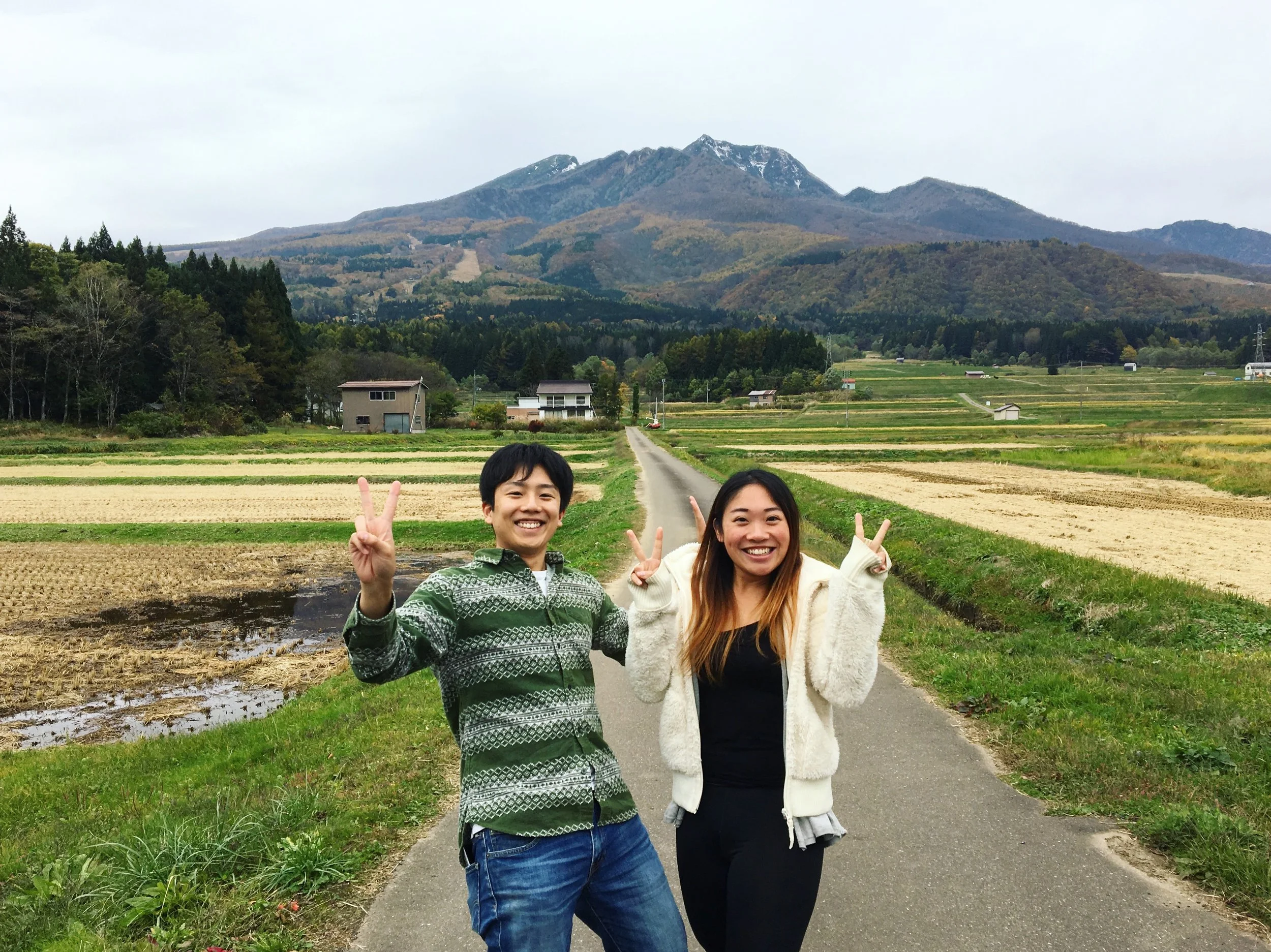
Cara (with a friend) in her JET placement of rural Niigata, Japan.
“My goals were to achieve N1 on the JLPT test and to visit every prefecture in Japan. I felt like I should be able to reach N1 given my background in Chinese. I also just love to travel and Japan has so many unique places that I want to experience. Even just my time in Osaka as a child left such an impression on me, I was excited to see what other places in Japan could make me feel.”
“My placement was anything but convenient, my usual 45 minute commute to work everyday would turn into an hour and a half commute in the winter because of poorly plowed roads. I expected some challenging moments, but this was far more than I was expecting. I also got into a car accident that damaged my car pretty badly and by the time I got home some days I couldn't even open my door because of how high the snow would pile up in front of my house! My first winter definitely tested me. I was also going through a lot of hardships personally and relationship wise. It was a real struggle to go to work every morning. Above all, the cold made me feel helpless and lonely. But luckily, I had many helpful Japanese neighbors who would check on me and make sure I was okay, which was very heartwarming!”
Being prepared for one hardship is expected, however when a combination of things go south in one's life, it can catch many unprepared. The culminating effects of moving to Japan often doesn't surface until a few months into the JET experience. Initially Cara struggled to build rapport with her coworkers and students, trying to justify a detour in her career and adapting to yet another new environment away from her family. The JET experience requested Cara to once again define who she was and where she belonged.
Growing up in three different countries, you seem very aware of how people view you. Your upbringing was not typical and perhaps difficult to explain. How did you connect with the students and teachers?
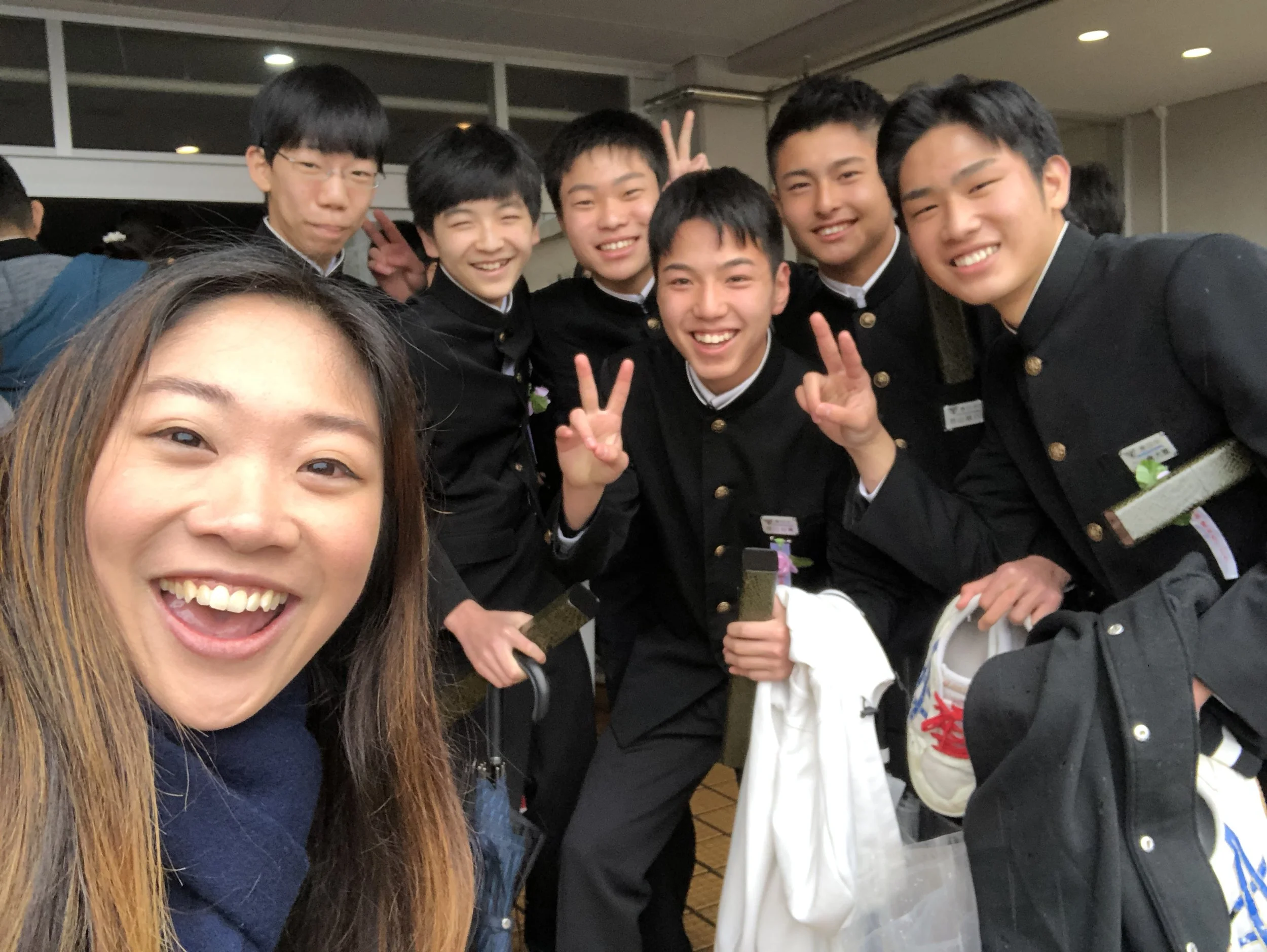
Cara with a few of her middle school students in Niigata.
“I think being an Asian foreigner in Japan is something that maybe isn’t talked about often. It was difficult explaining my background to the students. In a way though, my appearance and story gave them confidence. I had to learn English too and understood what they were going through. I had an idea about the social dynamics of Japan, but experiencing it was something else entirely.’’
Cara was determined to make connections. As her Japanese proficiency increased she was able to express herself more. In tandem with her almost pesky persistence, she made incredible bonds with the students and teachers that continue even today.
“I kept showing up, having lunch with the kids almost everyday. I played games with them everyday, that's how I was able to connect. It's amazing really. After JET years later, one of my students was on a US exchange program and we met up in San Francisco and I even visited her in New York! Not to mention my wedding ceremony. Almost a dozen people from my time in Niigata and Tokyo are coming to that!’’
After two years in the Niigata inaka, Cara wanted a more urban environment where she could expand her network and return to a faster pace of life, so she made the move to Tokyo.
What are some things you learned about yourself? How did living in Japan help you professionally?
During her time in Niigata, Cara briefly hosted a blog and YouTube channel that, to her surprise, gained a decent following rather quickly, helping her realize that she enjoyed the process of diving headfirst into new topics and creative writing. She leveraged this interest into a freelance writing career while living in Tokyo. She also excelled at making connections and her cross cultural experience would prove invaluable in her new role as a recruiter.
A full year in Tokyo helped Cara realize Japan would never truly be her home. She felt as if she was losing a part of herself adapting to life in Tokyo. Work culture, daily interactions and the high expectations she had for herself in addition to the expectations of others were taking its toll.
“I was losing myself. I noticed that I was becoming less and less like myself. I think that's something not talked about living and working in Japan. To some extent the more aggressively you conform, the easier it is to make connections. As an Asian female there was a lot of pressure to conform to both social and hierarchical norms. I also didn't have much of a creative outlet outside of the occasional freelance writing I did.’’
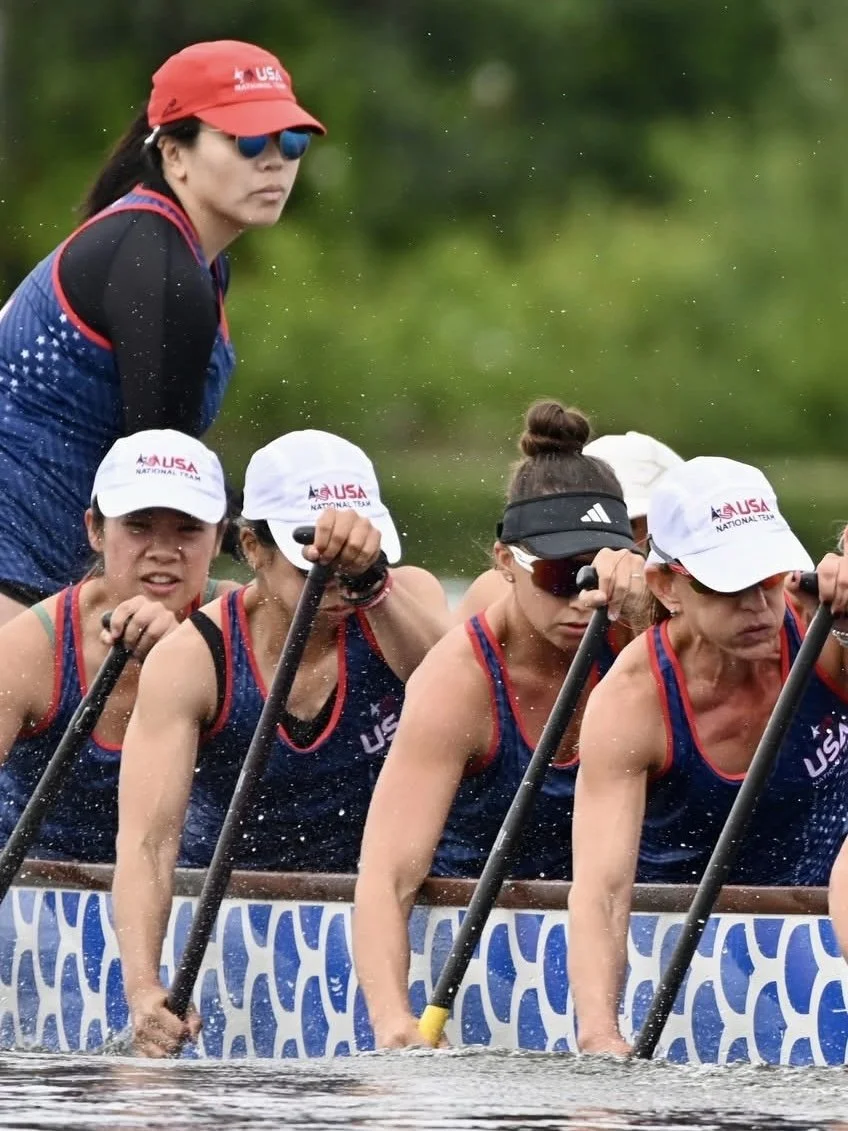
Cara on the far left with paddle in hand.
“I was weighing my options. I knew I wanted to go back to the US eventually, but the path towards that wasn't clear. I thought about graduate school and I began to study for the GRE and I even had an interview with Baylor University. Becoming a clinical psychologist was the original plan, but I changed a lot since coming to Japan and I wasn’t sure that's what I really wanted anymore. The graduate school path didn't work out, but I made some other connections through my freelance writing.’’
In the midst of transitioning to a new field she dealt with her fair share of rejections. However, despite battling imposter syndrome and a lack of experience, she pressed on.
“I decided to explore the writing path a bit more. I applied to more writing jobs than I can count. Everything from travel writing to finance to culture. I also got rejected a lot for those positions. I mean a lot, like over 200 rejections. I knew that this was something I wanted to do though, so I kept trying.’’
Eventually, Cara landed a writing job in New York City.
Cara had been wrestling with the idea of where home was. Her ability to adapt and be successful professionally in Japan did not necessarily mean she was completely comfortable there. Now, she was looking to reconnect to her Hong Kong roots and experience American culture again. New York was where that would be possible and a place where her individuality could shine a bit more. Coincidentally it was during this time she found, and fell in love with, the sport of dragon boating.
Dragon boating is a water sport originating in Southern China over 2,000 years ago, where teams of up to 20 paddlers including a drummer race in decorative boats resembling dragons. The sport emphasizes teamwork, rhythm, and being in sync with the drummer who is sets the pace for the paddlers.
You recently competed in the World Dragon Boat Championships. Can you talk about your path to accomplishing that amazing feat?
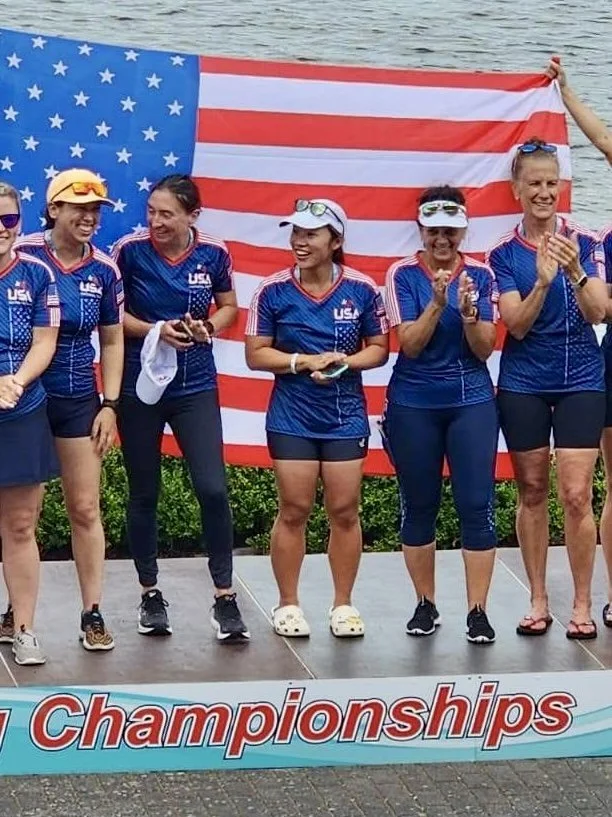
Cara, center stage, at the World DragonBoat Championships in Germany, summer 2025.
“In New York I found out there was a dragon boat club. I knew about the sport growing up in Hong Kong, but I really never tried it until then. I fell in love with the sport. I think it's the teamwork aspect and the fact that you know everyone is so committed and working just as hard as you. The intensity of the water splashing and seeing the boats around you...’’
Cara continued living in New York, developing her writing skills and discovering her passion for describing user experiences in UI/UX. She achieved something she envisioned for a long time- using her background in psychology and cross cultural perspectives to write about user experiences with technology. She landed a lucrative position at Instagram.
“Life was great, paddling on the weekends, working a job I loved…then…I got laid off. That hit me really hard. I finally thought I had caught up in life, professionally and socially. I lost so much when that happened. But I felt like it was important to describe how I was feeling in some way. I learned from my time in Japan that reaching out and being of service helps me get through hard times.’’
Cara would go on to share her experience with getting laid off and divert her attention to helping others through that process by being vulnerable in her personal and professional blogs. At this point there were few things that seemed guaranteed in her life. It was dragon boating that anchored Cara to a routine. Cara poured her frustrations, sadness and anger and the remaining hope she had left into dragon boating. In just six months she paddled nearly 1,000 miles, getting in the best shape of her life mentally and physically. Cara had her sights on competing professionally and being on the US National Dragon Boat team.
Cara eventually found employment, but her devotion to the sport that reinvigorated her life would not be diminished. Cara moved back to sunny Los Angeles, a place where she could paddle year round. She made the US National Team by persevering through a long and difficult tryout process.
She was proud to represent the United States in the World Dragon Boat Championships in Germany this past year. Through her work ethic and competitiveness she gained the respect of her teammates and coaches. The experience was exhausting but gave her a fresh set of new goals as a paddler. The sport that originated in Southern China and Hong Kong returns there for its 2027 World Championships. Cara looks forward to competing and reconnecting with her family there.
Do you have any advice for future JETs?
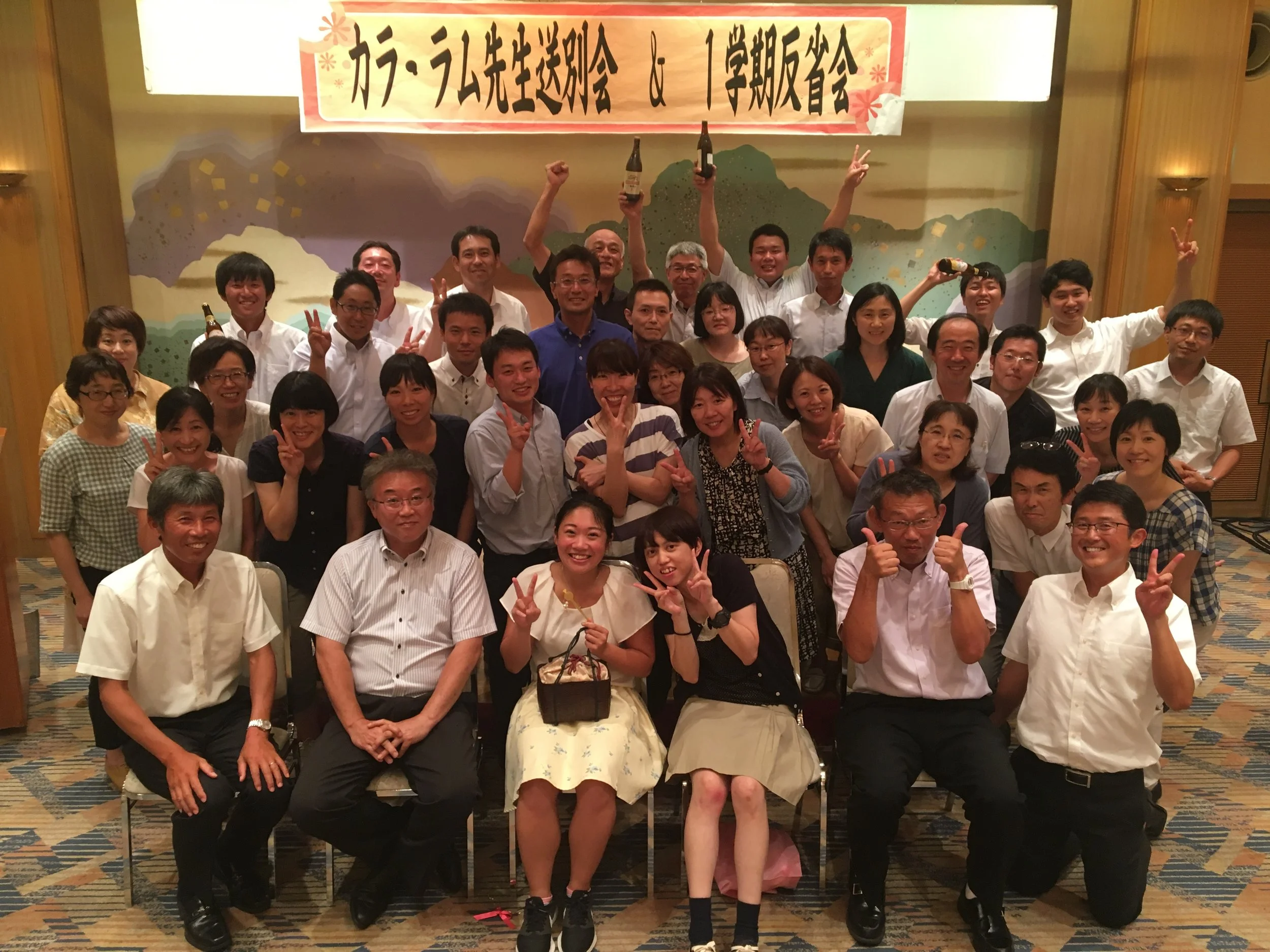
Cara (front, center) with some her work colleagues from her time on JET.
“Make the most of your time. It can be very easy not to do much and just do your job and go home. JET is about all the extra things you do outside of that. How are you connecting to yourself and the people around you? How does their existence change because they knew you? These are the questions I would ask myself and I wanted to make sure I made a difference.’’
The effect of Cara's warm personality and willingness to help her friends and colleagues came to fruition one winter night. She recalls her most memorable moments in Japan.
“I remember it was on my birthday. It was a terrible winter day and I had just gotten into a car accident. I was supposed to meet some friends at my place that day and I was extremely late. I wasn't sure if I was going to make it back through the snow storm and leaving fifteen people waiting outside was not ideal. I don't think I should have even been driving then, my stress levels were through the roof! So here I am driving home wondering where my driveway is and how I am going to muster the energy to shovel a mountain of snow to be able to get into my house. I assumed everyone had left already.Then in the middle of the storm I could see people around me shoveling snow to make space for me. Some of them were shoveling with their bare hands! I couldn't help but get really emotional that they stayed and waited for me. I knew then I had made some really special connections.’’
Any final thoughts on your JET experience and where it's taken you?
“Everyone has a story, there's a reason why we are here at this moment and place. It's important to learn about the stories around me. Story telling is what makes us human and able to connect with one another.’’
Cara's next adventure in life is still in the works. Through the JET Program she gained important life experience and teamwork skills that propelled her to become one of the best paddlers in the world representing the United States. Her commitment to herself and others and daring to choose a nonlinear path to success is inspirational. Cara's ability to make lasting connections has undoubtedly left an impression on the people she met. A beautiful reminder that we can do the same if we listen to the stories around us.
About Cara Lam (Niigata, 2016-2018)
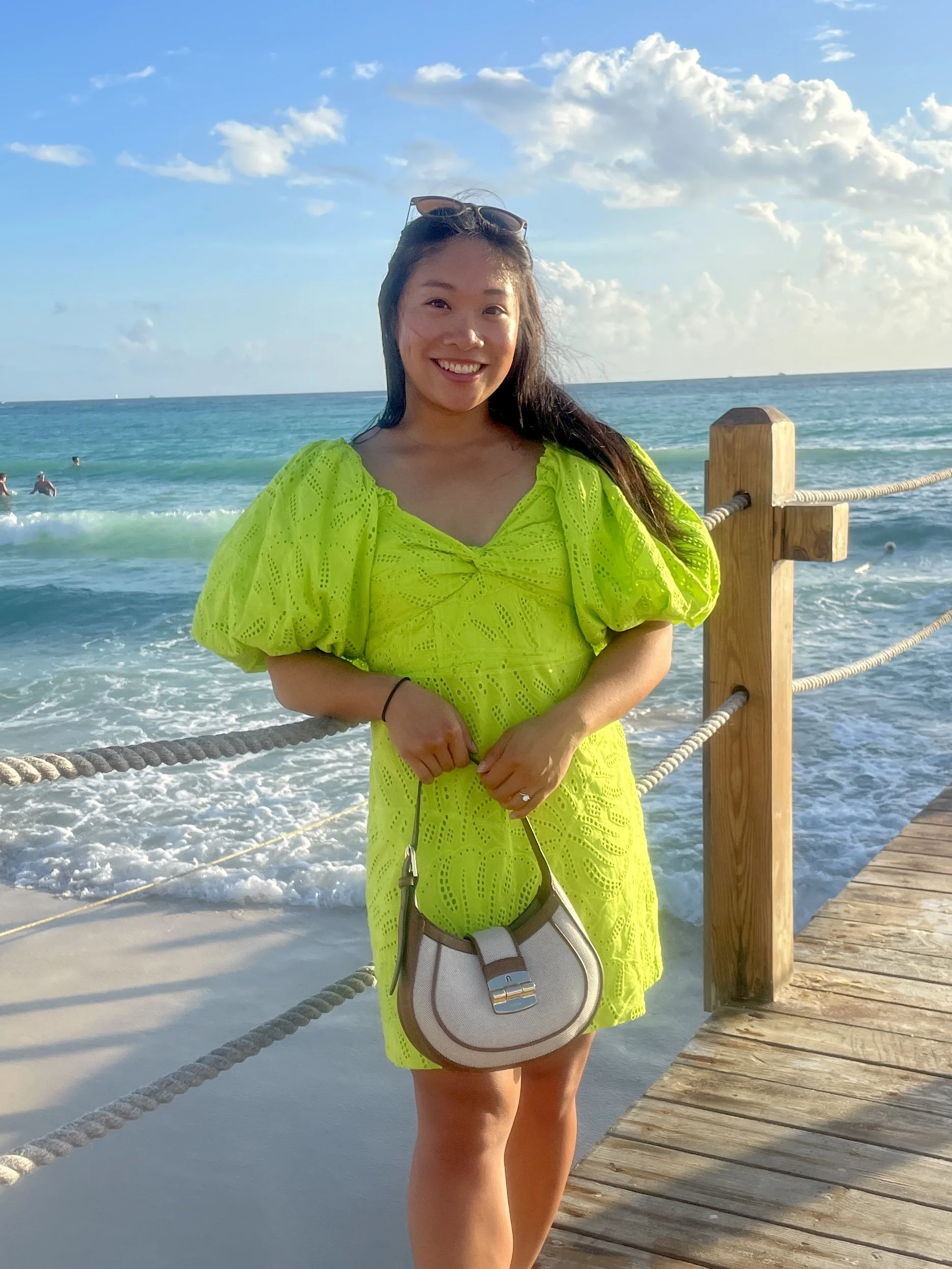
Cara Lam, originally from Hong Kong, has spent slices of her life in Australia, Japan, and the US. After spending 2 years in Niigata on the JET Program and 1 year in Tokyo, she moved back to the US and now works as a user experience writer for tech companies. Although her Japanese is getting rusty, she holds her JET memories close to heart and visits Japan often to relive the moments. In her free time, she likes to paddle! Cara represented Team USA Dragon Boat team at the 2025 World Championship in Germany and hopes to continue living the water lifestyle in the future.
You can keep up with Cara’s adventures through her blog: Caradventures.
The Senpai Spotlight series is brought to you through partnership between USJETAA and AJET’s CONNECT Magazine. The series features JET alumni from the US who have made successful careers for themselves in various fields—with the goal of inspiring young JETs and JET alumni to pursue their own dreams while also offering some words of advice only a senpai could know.
If you, or someone you know, would like to be featured as a Senpai Spotlight, please reach out to us at contact@usjetaa.org.
This edition of Senpai Spotlight was written by Bobby Nawbary, a passionate writer who recently graduated with a Masters in Teaching English and found his way to Aomori with the JET Program. His interest in language and culture has led him to volunteer within State Department cultural exchanges and international student programs. He currently serves National AJET as Director of Professional and Educational Development and enjoys presenting his research at various conferences which involves helping students transition into higher education and become lifelong language learners. You can see more from Bobby at Good Morning Aomori, a long-standing JET-run publication.
